


Controlled drinking and the MPU – is it possible?
A clear assessment instead of self-experiments – directly with MPU experts.

Controlled drinking can be accepted in the MPU under certain conditions. Whether controlled drinking is possible in your case or abstinence is required depends on your history, the offence and the specific reason for your MPU.
What does controlled drinking mean for an MPU?
Under certain circumstances, controlled drinking is a sensible alternative to complete alcohol abstinence. Both controlled drinking and alcohol abstinence are about reliably avoiding alcohol consumption/intoxication in connection with road traffic.
What is the aim of controlled drinking (CD) in the MPU?
The aim is to reliably separate alcohol and driving in order to ensure road safety for all road users. In many cases, alcohol abstinence is not required for a positive medical-psychological assessment (MPU). The MPU assessor wants to see that your goal is a lasting change in behaviour – namely moderate, controlled drinking that is consistently kept separate from driving.
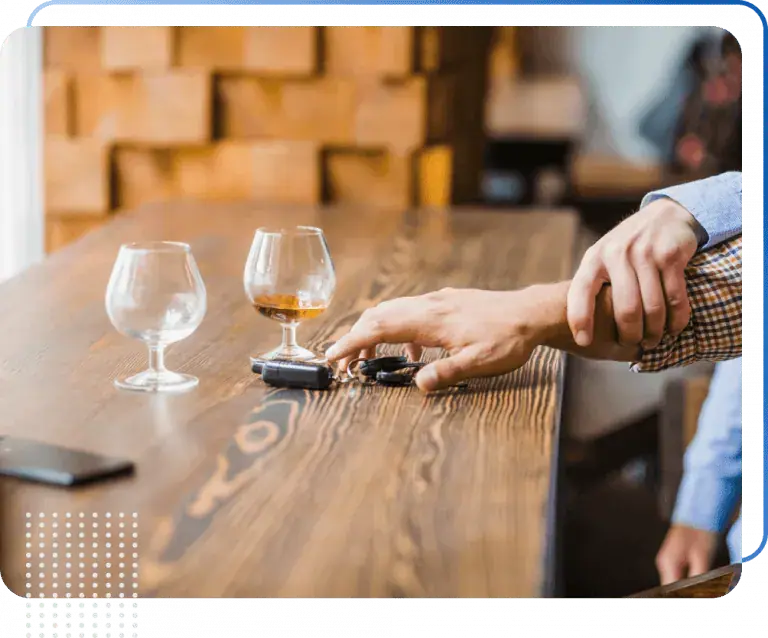
Which conditions must be met for controlled drinking in the MPU?
- Blood alcohol level below approx. 2.5 ‰
(In individual cases, controlled drinking can still be argued for levels above 2.0 ‰. Many websites state a limit of 2 per mille, but in practice this does not hold.) - No repeat offence
(If you have been caught with alcohol several times, controlled drinking is not ruled out, but it is much less likely) - Age and potential for change
(Younger people usually have a greater potential for change – but older people can also successfully present controlled drinking in the MPU if they can credibly demonstrate changes) - Time of offence and drinking pattern
(No advanced drinking patterns, e.g. with negative consequences for health, private life or work)
These points are the most important guidelines. Whether controlled drinking is actually possible for you always depends on your individual case.
It is therefore important to get comprehensive information in good time, because proof of abstinence for 6, 12 or even 15 months may be required. Further information can also be found under Shortening abstinence and MPU without proof of abstinence. We are happy to look at your individual case together in a free initial consultation. Appointments are available online and can be booked immediately.
Controlled drinking in the MPU is not a self-experiment
Drinking rules alone are not enough. In the MPU, what counts is whether your approach is psychologically coherent, consistent and realistically explainable. This is exactly where many fail – despite supposedly correct rules.
- Appointments bookable online
- Free of charge
- No obligation
Whether controlled drinking is possible for your MPU depends on several factors:
In the following section you will find details on the points blood alcohol level, repeat offences, age and potential for change, and drinking pattern, which you can use for orientation.
The blood alcohol level
There is no absolutely binding limit, only a rough guideline: from around 2.5 ‰ BAC, controlled drinking may be advised against. Under certain conditions, controlled drinking can still be considered for levels well above 2 per mille. We are happy to check your individual case.
Age
The MPU assessor generally attributes considerably more potential for change to a younger person, because a lot usually still changes at this stage of life (career, training, starting a family, etc.). The chances for controlled drinking are higher in this case.
The average 50-year-old, on the other hand, usually lives in fairly entrenched patterns. Against this background, habits and routine often play a much more important role at this age. Statistical studies show that with increasing age, the way people handle alcohol is usually quite entrenched and has been practised for many years. Switching to controlled drinking is therefore rather uncertain and much more difficult than for younger people. Complete abstinence from alcohol is therefore the more promising alternative.
Time of day and day of the week
This information is regarded as a very significant indicator of the extent to which alcohol may already be an essential part of your life. Someone who drinks a lot at the weekend does not necessarily have problems at work or in other areas of life.
However, anyone who has been caught driving under the influence during the day and/or on weekdays is very likely to have been unable to fully meet their professional obligations, for example, or to have alcohol-related problems in other areas of life. That would be a clear sign of an advanced alcohol problem. Controlled drinking would then definitely no longer be possible.
Am I a repeat offender?
Anyone who has been caught with alcohol in road traffic several times is considered a repeat offender. In such cases, it is much less likely that controlled drinking will be accepted. Often – and also according to the official assessment guidelines – assessors do not accept controlled drinking here, but require complete abstinence from alcohol.
The four criteria allow a fairly reliable assessment of whether controlled drinking can still be accepted. However, a clear decision is rarely possible, as the overall picture counts: the more unfavourable factors there are, the less likely controlled drinking becomes.
If abstinence is required, binding proof must be provided in accordance with the CTU criteria (e.g. 4 urine samples in 6 months, 6 urine samples in 12 months or hair analyses every 3 months). There may be no more than 4 months between the end of the proofs and the MPU – longer gaps must be plausibly explained.
Controlled drinking in the MPU is not a self-experiment
Drinking rules alone are not enough. In the MPU, what counts is whether your approach is psychologically coherent, consistent and realistically explainable. This is exactly where many fail – despite supposedly correct rules.
- Appointments bookable online
- Free of charge
- No obligation
Which rules are particularly important for controlled drinking in the MPU?
Controlled drinking (CD) refers to a pattern of consumption in which the person retains the freedom to drink to a predetermined extent in predefined situations (setting a drinking plan and drinking rules, including the amount and conditions such as place and time). It makes sense to set 3 goals per week in such a plan:
- The number of alcohol-free days
- Maximum amount consumed on drinking days
- Maximum total consumption per week
More tips for controlled drinking with a plan:
- Only drink on planned and special occasions.
- Decide how often per month you want to drink in a controlled way at most.
- Your blood alcohol level should not exceed 0.3 per mille. You must always be in control.
- Controlled drinking – how much? Specify exactly the maximum number of drinks you want to have at a party (for example, a maximum of 2 beers of 0.33 l each).
- Never arrive by car at planned drinking occasions.
- Plan the journey there and back in advance, take money for a taxi just in case, or install a taxi app or Uber beforehand.
Controlled drinking – what experience is there with the MPU?
If you fall into category A3 and controlled drinking is possible, and you consistently drink moderately with fixed rules over a period of several months, you will pass your MPU. Experience is very positive. With controlled drinking there is no proof as there is with complete abstinence. However, you must credibly and comprehensibly show the assessor that you drink moderately. Your liver values must not be elevated either (GOT, GPT, GGT). If the assessor doubts that you are implementing controlled drinking successfully and consistently, they will request a hair analysis, which can prove or disprove moderate consumption. If you decide on controlled drinking, you must not cheat, because the assessor could find out via a hair sample, and then your MPU is guaranteed to be negative.

Controlled drinking – experiences
Experience shows that in many cases controlled drinking is a sensible alternative to alcohol abstinence. However, it has also repeatedly been shown that controlled drinking does not run by itself and that relapses into old drinking patterns can occur. Clarify your individual case in a free initial MPU consultation with one of our traffic psychologists. Appointments are available online and can be booked immediately. Further information on our preparation and the requirements for a positive MPU can also be found under MPU counselling.
Controlled drinking in the MPU is not a self-experiment
Drinking rules alone are not enough. In the MPU, what counts is whether your approach is psychologically coherent, consistent and realistically explainable. This is exactly where many fail – despite supposedly correct rules.
- Appointments bookable online
- Free of charge
- No obligation



Book your free MPU initial consultation
Free · Personal · By phone or video